





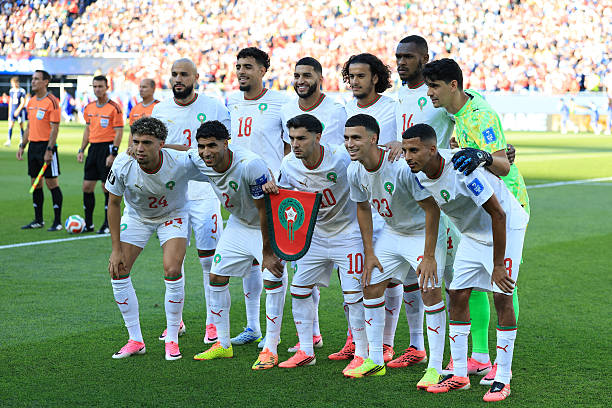
Morocco continues to attract attention at the 2026 World Cup. In an analysis published by the Dutch media outlet Voetbalflitsen, the Atlas Lions are presented as a potentially more challenging tactical opponent for the Netherlands than Brazil.
While the Oranje have taken a significant step towards the knockout stage after their decisive victory against Sweden, attention is already turning to Group C. In this group, Morocco and Brazil appear as two possible opponents for the Dutch team in the next round. On paper, many might think it is better to face Morocco than the Seleção. However, according to Voetbalflitsen, the tactical reality is much more nuanced.
Morocco, a feared opponent for the Netherlands
The Dutch media first reminds us that Brazil remains a team filled with stars, featuring players like Vinícius Júnior, Raphinha, Bruno Guimarães, Marquinhos, and Alisson. However, the article also highlights that the team led by Carlo Ancelotti has not always displayed perfect collective balance since the start of the competition.
Against Morocco, Brazil was notably unsettled by the organization, intensity, and discipline of the Atlas Lions. For Voetbalflitsen, the Seleção’s weakness does not lie in individual quality, but rather in its balance. This factor could provide more space for the Netherlands in the event of a confrontation.
In contrast, Morocco is portrayed as a team less impressive in terms of prestige but much more difficult to control collectively. The Atlas Lions know how to defend compactly, close down the center, play out cleanly under pressure, and exploit spaces with speed and intelligence.
Hakimi, the tactical puzzle for the Oranje
One of the central points of the analysis concerns Achraf Hakimi. The right-back from Paris Saint-Germain is presented as one of the most challenging players for the Netherlands to manage.
According to Voetbalflitsen, Hakimi does not limit himself to a classic role as a full-back glued to the touchline. In the Moroccan setup, he can push very high, cut inside, occupy half-spaces, or even position himself as an additional player between the lines. This freedom of movement forces the opponent to make complex tactical choices.
If the Dutch left winger follows him, the Netherlands risks losing a transition option. If a midfielder steps out to confront him, spaces may open up in the midfield. And if the left-back pushes up to control him, depth can be attacked behind him. It is precisely this type of dilemma that makes Morocco difficult to read.
Saibari, Ounahi, and El Khannouss change the dimension of Morocco
The Dutch site also emphasizes Morocco’s progression in play. The Atlas Lions are no longer just a solid defensive team. Under the guidance of Mohamed Ouahbi, they also have players capable of playing out from the back and creating shifts between the lines.
Ismael Saibari is particularly highlighted. A scorer against Brazil and then against Scotland, the Moroccan midfielder brings projection, pressing, and a real offensive presence. His ability to attack spaces between the lines could pose serious problems for the Oranje.
Together with Azzedine Ounahi and Bilal El Khannouss, Saibari provides Morocco with valuable technical quality to withstand pressing and accelerate the game at the right moment. For Voetbalflitsen, this collective profile could disrupt the rhythm of the Netherlands.
Brazil More Dangerous, Morocco More Difficult to Maneuver
The analysis makes a clear distinction between the two possible opponents. Brazil would be more dangerous due to its individual talents, particularly with Vinícius Júnior, who can turn a match on a single action. However, this team could also leave more spaces for the Netherlands, especially in transition or behind the full-backs.
Morocco, on the other hand, would offer a more closed, tactical, and demanding match. The Atlas Lions can defend deep, reduce spaces in the center, force the opponent to go wide, and then quickly counterattack with technical and mobile players.
For a Dutch team that is sometimes less comfortable against compact blocks, this type of match could be particularly challenging to manage. Voetbalflitsen thus estimates that the Netherlands would likely face more problems against Morocco than against Brazil.
Brazil More dangerous, Morocco more difficult to maneuver
The conclusion of the Dutch media is indicative of the growing respect surrounding the Moroccan national team. Brazil remains the most dangerous opponent on paper, due to the quality of its players and its history. However, Morocco could be the most uncomfortable tactical opponent.
This analysis confirms the new dimension taken by the Atlas Lions on the international stage. Morocco is no longer seen merely as a combative and difficult-to-beat team. It is now regarded as a national team capable of posing real tactical problems to major nations, thanks to its organization, discipline, and the versatility of key players like Achraf Hakimi, Ismael Saibari, or Azzedine Ounahi.
